- Kind
- Chess
- Players
- You and the computer, or two people
- A round
- One game; no chess clock
- Runs on
- Phone or desktop browser
What you do
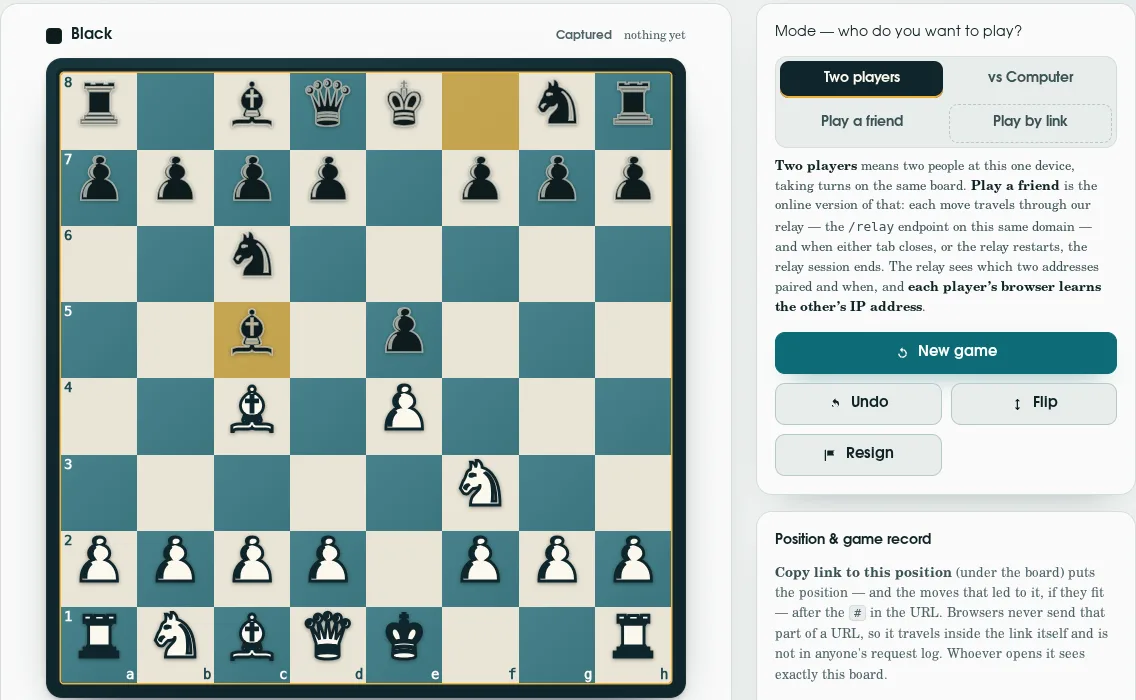
It is chess with the full rules — castling, en passant, promotion, check and mate — and four ways to sit down: vs Computer; Two players on one device, passing it across the table; Play a friend, live on two devices, paired by a link one of you sends; and Play by link, where each move travels inside the link itself and a reply an hour or a week later opens the same game. You pick White, Black or Random.
The computer has three strengths. Easy looks one half-move ahead, Normal two and Hard three, and all three then follow captures a little further before scoring. Easy also picks at random among moves within two and a half pawns of its best, Normal within 0.9 of a pawn, and Hard takes its top move every time. It opens on Normal and can be changed mid-game. The engine runs in your browser, so a game against it makes no server round-trip.
Strips above and below the board count captured material at the beginner's values — pawn 1, knight 3, bishop 3, rook 5, queen 9. The front page at dankchess.com teaches as well: ten openings move by move, six tactics boards you play rather than read, and three basic endgames.
Controls
Phone
- Tap a piece to see its legal moves, then tap a square — or drag the piece.
- Buttons beside the board: New game, Undo, Flip, Resign, and draw offers in a game with a friend.
Keyboard and mouse
- Arrows
- move a cursor over the board
- Enter Space
- pick up or put down, as a click would
- Esc
- drop the selected piece
- ← → Home End
- step through the move list
How long a round takes
There is no clock: a game lasts as long as the two of you take over it. Against the computer the length is yours to set. Play by link is built for slow games — nothing waits on anybody, and the link reopens the same board days later.
The honest limits
Play a friend sends each move through a small relay on dankchess.com that sees which two addresses paired and when; its chat goes browser to browser, so each of you learns the other's IP address and nobody moderates it. If either tab closes or the relay restarts, that session ends — the board survives in your tab, and its resume link starts a fresh game from the same position. Play by link has no chat, and whoever holds the link can move for either side.