DANKGAMES

An indie game label making small, weird, replayable games. Every game below is free and runs in a browser tab, with nothing to install and no account to make — you open the link and you are playing.

Six games are live, and there are six cards below. Nothing gets listed on this page until you can actually play it, so a card here is always a link to a game that runs today.

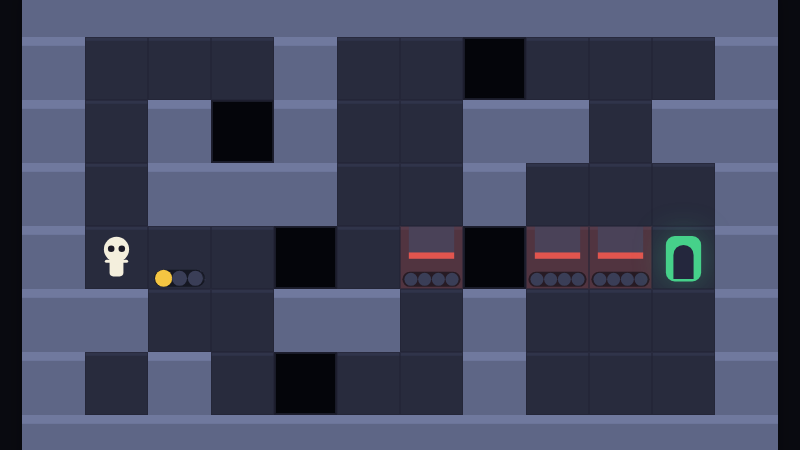
Playable now A DEAD WEIGHT dungeon room: a skeleton stands at the left of a tiled grid, three red spike traps and several black pits sit between it and the glowing green exit door on the right.

DEAD WEIGHT 💀

Turn-based puzzle · 25 rooms + a new one every day · phone or desktop

A grid dungeon you cannot clear in a single life. Every death leaves a corpse lying exactly where it fell, and that corpse is now terrain — it bridges the pit, it jams the crusher, it eats the arrows meant for the next you.

Play →

How a room plays, and the room for every date

Clearing a room is a routing problem rather than a reflex test, because the board only moves when you do: a swipe or a tap along your row or column on a phone, the arrow keys on a desktop, and every cell you cross spends a turn, so the spikes and crushers step forward while you walk and hold still the moment you stop, and retry is instant. Twenty-five rooms in one fixed order, the same twenty-five for every player, even the cheapest of them costs you two bodies, and when a room takes more bodies than it should you can take one back and play that death again. When the thing in your way is a beat rather than a wall, the Wait control under the board spends two turns in a single press instead of making you shuffle back and forth to burn them.

The twenty-five are not all of it: the same generator that builds the early rungs has a room waiting for every date from 2020-01-01 to 2099-12-31, so there is a new room every day. That date string is the entire seed, so everyone who opens a given day gets the same board, and nothing is handed out until an exhaustive solver has proved the room cannot be cleared on fewer than two bodies. It is a side door rather than the front one: add ?day=YYYY-MM-DD to the game URL — today's date for today's room, ?day=2026-01-01 for the one from New Year's Day. A bare link still opens level 1 of the fixed ladder, and since a date is not a rung, the share button is hidden there.

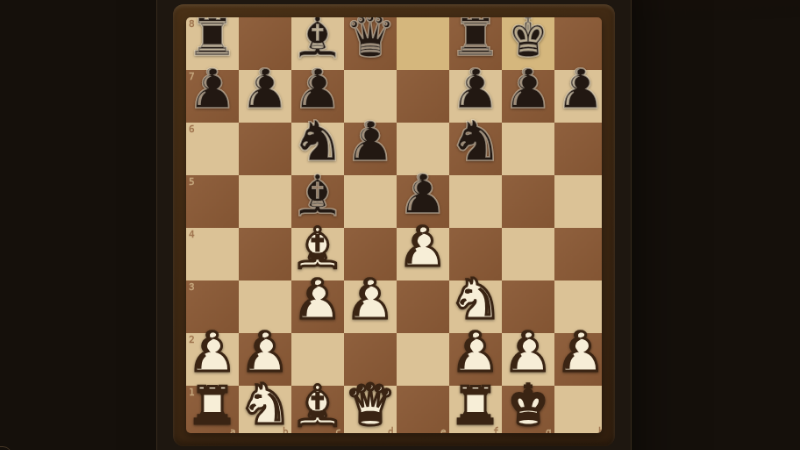
Playable now A DANK CHESS board part-way through the Italian Game opening: pawns on e4 and e5, knights and bishops developed toward the centre, and both kings already castled on the kingside.

DANK CHESS ♟

Play a friend · or the computer · openings and tactics

A chess board that pairs two people over a link: one of you sends it, the other opens it, and you play from two separate devices with no account on either side. You can also play the computer, or hot-seat a single board with whoever is sitting next to you.

Play →
What else this board does

The link-paired game carries a chat box that runs browser to browser when that connection can be made, and when it cannot, the game simply carries on without it. The same page teaches as well as plays — it walks the main openings move by move, Italian, Ruy Lopez, Sicilian and others, covers the rules that catch people out, and hands you six tactics boards where you play the move instead of reading about it.

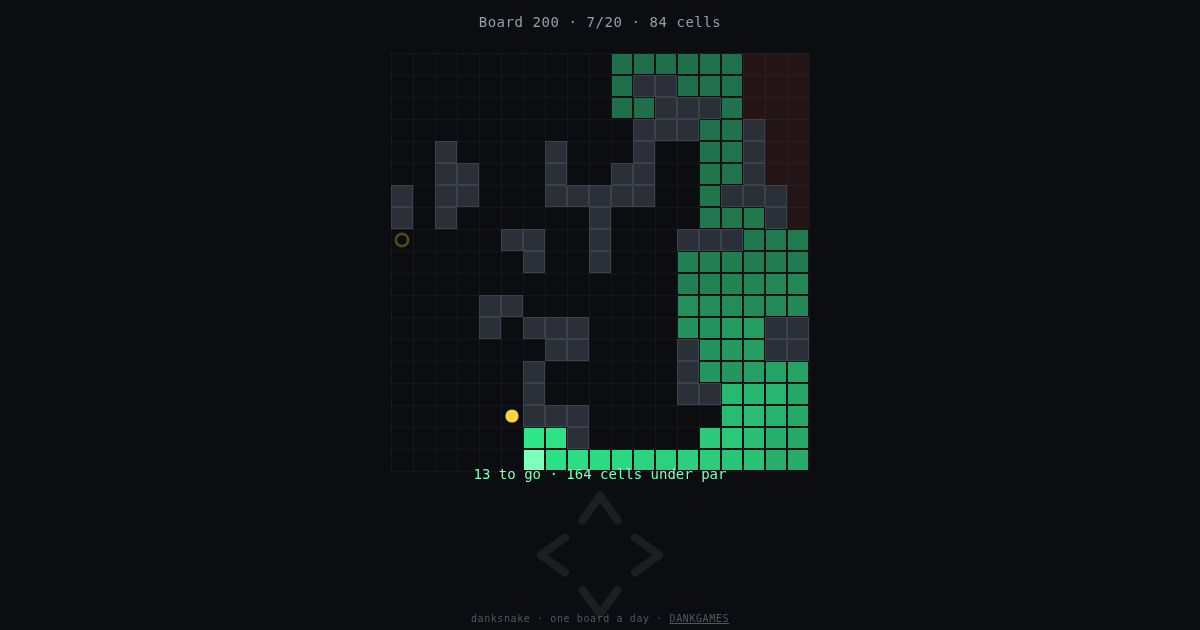
Playable now A real DANK SNAKE run captured mid-board on board 200: a 19-by-19 grid on near-black, with the green trail the run has already walked filling most of the right-hand third plus a band across the top, brightening to mint where the trail ends along the bottom rows. Slate-grey rock blobs are scattered over the board, thickest down the still-empty middle and left. One gold pellet is lit low and left of centre, a short way ahead of the trail's end, and a dim gold ring out on the far left edge marks the pellet due after that one. A patch of cells in the top-right corner carries a faint red wash: ground the trail has already sealed off. The line above the grid reads "Board 200 · 7/20 · 84 cells" and the line below it "13 to go · 164 cells under par", with four dim arrow chevrons under that for the tap targets and the footer "danksnake · one board a day · DANKGAMES".

DANK SNAKE 🐍

Daily snake puzzle · the same 19×19 board for everybody · one thumb, on a phone

A snake whose tail never shortens. Everywhere you have been stays filled, so the board closes up behind you as you eat, and the only real question is how much of today's grid you can take before you have walled yourself in.

Play →

How a run ends, and the honest limits

Everybody gets the same board each day: 19×19, built in your own browser out of the UTC date, with no account and nothing to install.

Twenty pellets are revealed one at a time, and the one due after the lit one is drawn as a dim ring, so a turn is a decision instead of a reflex. A run ends in exactly three ways: CLEAR if you take all twenty, DEAD if you drive into the border, a rock or your own trail, and STRANDED the moment the pellet you still need is walled off — the game says so there and then rather than making you prove it. You are scored on pellets first and cells second, against a par the board generator walked itself before the board shipped: board 251, the one for 2026-09-08, pars at 242 cells and has 50 of its 361 cells under rock. Steering is one thumb — tap the side of the screen you want to go, or use the arrow keys on a desktop. The honest limits: taking the short way to each pellet is precisely how you seal yourself in, and that route ended our run STRANDED on 8 of 20 after 77 cells; the snake is already moving the moment the page opens, so an untouched board is dead in about a second; and only your first three runs on a board are scored, the rest being practice. Older boards stay open — add ?b=251 to the URL for board 251, or any lower number for an earlier day.

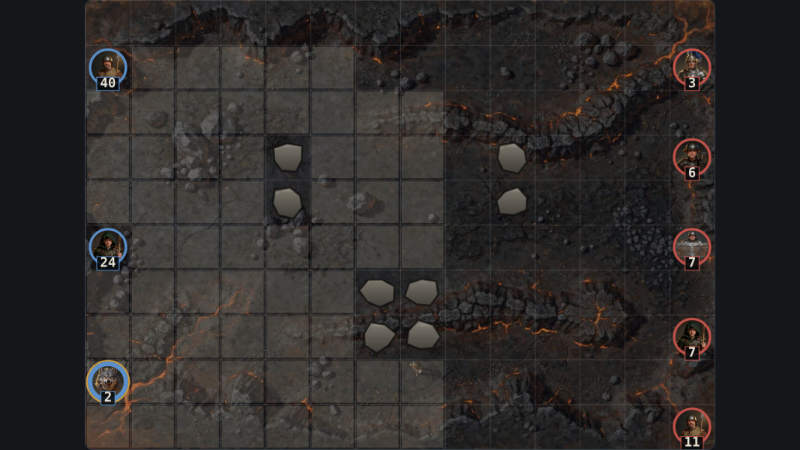
Playable now A DANKGAME battle at the top of round one, captured on the live site in a real match against the machine: both drafts have just been revealed, neither army has moved, and the ground is a 14×10 field of dark volcanic ground, ash-grey rock across the left half, charred black across the right, and orange lava veins running through both. Three blue-ringed stacks stand along the left edge — 40, then 24, then 2 — each token a portrait of the unit with its head count in a box under it; the pair of dire wolves at the bottom is ringed in gold rather than blue because it is the stack whose turn it is. Five red-ringed enemy stacks, 3, 6, 7, 7 and 11, are drawn up along the right edge facing them. Eight pale boulders sit in the ground between the two armies, placed in mirrored pairs either side of the centre line so the terrain favours neither side.

DANKGAME ⚔

Turn-based tactics · a thousand gold to spend · the machine, or two people from one link

A turn-based fantasy battle you can play on your own against the server, or with one other person from a link. A spearman costs 12 gold and a drake costs 260, so the same purse is eighty-three of the one or three of the other, and your opponent sees none of what you bought until both armies are standing on the field.

Play →
The draft, the battle, and the honest limits

The draft is the first half of the game. There are eight kinds of unit and room for five stacks: a spearman has 10 hit points and walks, a drake has 60, flies over everything and is the fastest thing on the roster. Pressing max on the spearmen really does buy eighty-three of them for 996 gold; the same button on the drakes buys three for 780 and leaves you a knight's worth of change. Buying wide and buying tall are both real answers, and neither of you finds out which the other chose until the armies are on the ground.

Then both armies appear at once along opposite edges of a 14×10 field, and the fastest stack acts first. A stack moves, strikes, shoots, braces, or waits for a better moment — and whatever you hit swings back, but only once a round. A stack is a group rather than a single piece, so damage comes off its head count: in the battle played to write this card, a stack of five archers hit a knight stack for 14 and killed one knight, and the knights swung back for 32 and killed four of the archers. The boulders scattered over the ground are mirrored across the centre line, so the terrain never decides it.

Nobody to send a link to? Press Play the machine and the server plays the other side: it is a program, not a person, it buys its army the moment you press, and it answers the instant you finish a move. Same rules, same board — one click, no account, nobody to wait for. The other way round is two people: one of you presses Start a match, gets a link and sends it to the other; it seats two, there is no account on either side, and anyone arriving third is told this match already has two players. Reloading does not end the match — the seat is held on the server, so a refresh drops you straight back into the same battle on the same round. The honest limits: there is no matchmaking, so the two-player game needs a link you send to someone yourself; there is no queue that will find you a stranger. And the server drops a match nobody has touched for six hours, which makes a stale link a dead one.
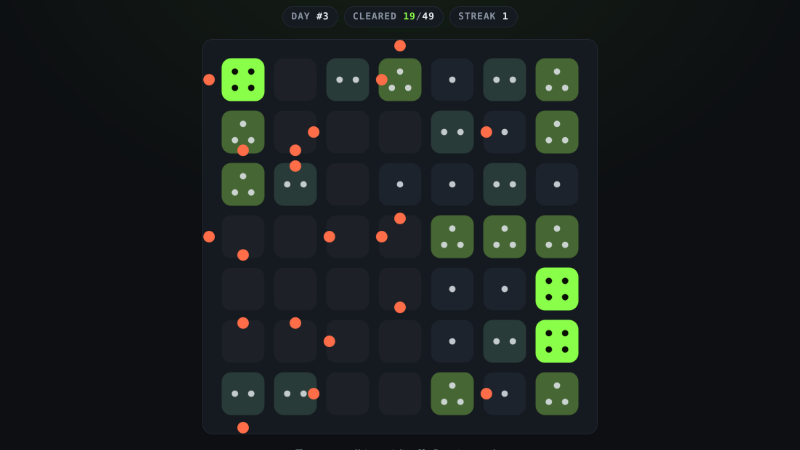
Playable now The CHAIN REACTION board for 2026-09-09 — board #3 — caught mid-cascade about seven tenths of a second after its one and only tap, which was played at the strongest of the 49 openings: a 7×7 grid of dark rounded cells, every surviving cell pipped like a die with one to four white dots and shaded a brighter green the fuller it is. Three cells are still lit bright lime at four pips — one in the top-left corner and two stacked at the right — each of them one bump from blowing. Nineteen of the forty-nine cells have already gone and sit blank, and orange sparks are in flight all across the board, up, down, left and right, several of them already past the edge of the grid. The pills above the board read DAY #3, CLEARED 19/49 and STREAK 1.

CHAIN REACTION 💥

Daily chain reaction · one tap on a 7×7 grid · alone · phone or desktop

A 7×7 grid of loaded cells, and you get exactly one tap on it. The cell you pick detonates and throws a spark up, down, left and right; each spark bumps the first cell it meets by one, and any cell bumped past 4 blows as well, so a single well-read opening can cascade across most of the 49 squares.

Play →

How each day's board is built

Everyone who opens the page on the same UTC day gets the same board, which makes this a decision rather than a reflex test: sparks fly straight through the gaps earlier blasts leave behind, so you can trace where a chain will run before you commit to it. Each day's board is auditioned rather than merely generated: the game solves all 49 possible openings and re-rolls, up to 400 times, until the best tap clears at least 18 cells, the fifth-best opening still manages 45% of what the best one does, and the median opening comes in at no more than 35% of it — so several taps are worth weighing and tapping at random is reliably punished. You get one tap on today's board and unlimited practice boards beside it, so learning costs nothing and the day still costs a single decision. Afterwards there is a result to copy: the cells you cleared, the best any opening on that board could have cleared, and a ten-square bar between them — no cell positions, so pasting it into a group chat spoils nothing for whoever reads it. Nothing goes to a server and there is no sign-up, so the streak counter sits in your own browser's storage and clearing your site data clears it.

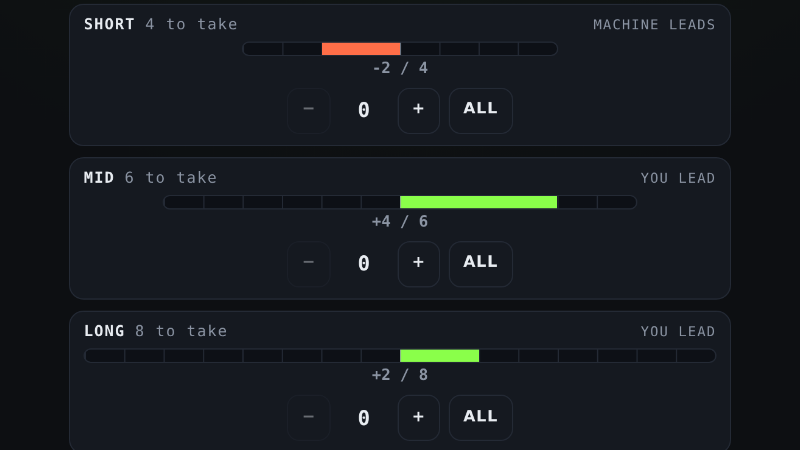
Playable now A LANES seat three rounds into a match against the machine, waiting on the fourth. The three lanes are stacked down the frame — SHORT, 4 to take; MID, 6 to take; LONG, 8 to take — and each carries a tick-marked track drawn as wide as that lane is long, so the long lane is visibly the long one. SHORT's bar is pushed left of centre and orange and reads -2 / 4, with MACHINE LEADS printed against it; MID's is pushed the other way and green at +4 / 6 and LONG's at +2 / 8, and both of those are marked YOU LEAD. Under every track sit a minus, a count and a plus with an ALL button beside them, and all three counts read 0, because this round's orders are placed in secret and have not been placed yet.

LANES 🛣

Secret orders · three lanes, fund two · the machine or a link · phone or desktop

Three lanes of unequal length, a budget you spend in secret, and a rule that you may fund at most two of the three in a round — so the lane you leave open is the decision, and taking two of the three wins the match.

Play →
Who you play, and what the link cannot do

Your opponent is the machine, or one other person you send a link to: it seats two, you both commit blind, and the orders turn over together. There is no server holding the match, so when the other tab closes it stops there, and starting again needs a fresh link. This and the daily puzzle above used to share one page at dankgame.com; they now have a URL each, and the front door there is DANKGAME.

All six links open the game itself: no store page, no email gate, nothing to buy, no demo build to upgrade out of. Every one of them you are playing within a second of the page loading, DANKGAME included: it will seat two people from one link, but it never makes you find the second person first.

The honest limit: DEAD WEIGHT keeps your run in your own browser's storage and nowhere else. There is no account and no server behind it, so your progress does not follow you to another device, and clearing your site data clears it. Sharing a cleared level means sending someone a link that carries your moves, not posting to a leaderboard — there isn't one.